

BoardTempo workshops · 3/8
One brand, two languages: plan distinct Pinterest profiles without splitting your identity
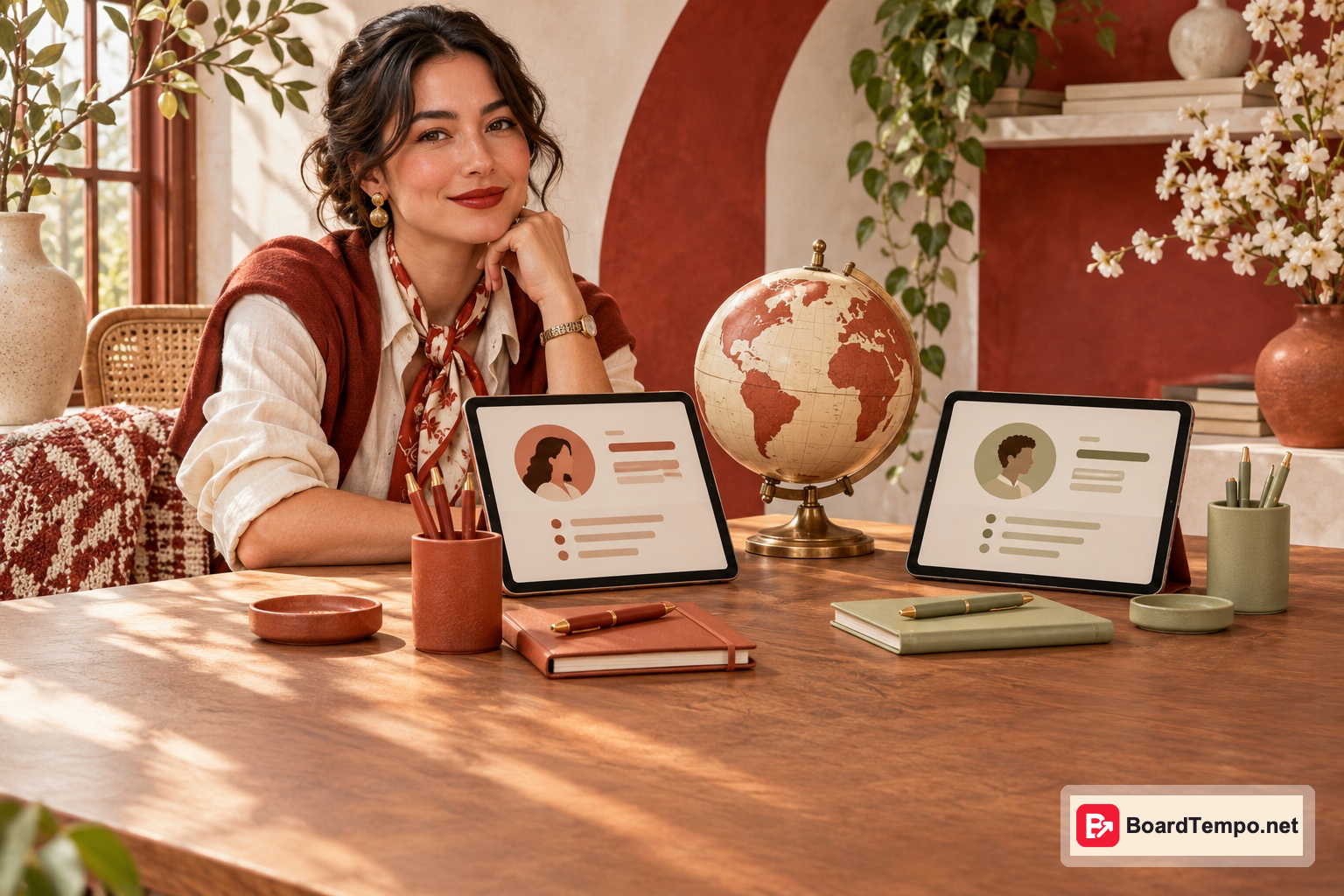
Your Russian profile says “workshop,” your English version says “creative studio,” and both links open the same untranslated catalogue. The avatars look identical. Which account did you just open? This is a good moment to stop translating individual sentences and map the whole experience.
This workshop is for a brand that has chosen separate Russian- and English-language profiles. It is not a Pinterest requirement or advice that every business needs two accounts. Separate versions make sense only when you can maintain both, answer people and deliver what each one promises.
Write two audience briefs before two bios
For each version, record the audience, offer, service availability, language of resources and next destination. Our invented example is a studio helping small maker businesses prepare visual content for Pinterest. One version serves Russian-speaking owners worldwide; the other serves English-speaking owners worldwide.
Language is not geography. Russian-speaking does not automatically mean located in Russia, and English-speaking does not automatically mean based in the United States. Define currencies, service regions, consultation times and seasonal examples separately.
The service may be shared while the examples differ. One audience may need an explanation of a term; another may ask more often about the difference between a planning consultation and full account management. Use actual reader questions rather than assumptions about nationality.
Make the name explain the business
An illustrative pairing could be “Студия Линия | Pinterest для мастерских” and “Line Studio | Pinterest for makers.” These are fictional editorial examples, not checked brand names or available usernames.
The display name and username are not the same field. Before changing an existing profile address, check where that address is already linked: your website, emails and other channels. Clarity should not come at the cost of breaking yesterday's invitation.
Use a small, consistent RU or EN marker on the avatar if it helps your team distinguish the profiles. Keep the core brand mark shared. Test the marker at a small size: it needs to work in an account switcher, not just on the designer's large monitor.
Draft bios that describe real resources
An English example: “Pinterest content planning for independent makers. Explore practical pin examples, product-photo ideas and clear publishing workflows. Visit our site for resources and ways to work together.”
A Russian example: «Помогаем небольшим мастерским превращать свои изделия в понятные материалы для Pinterest. Показываем разборы пинов, идеи съёмки и рабочие планы. На сайте — примеры и форматы помощи».
Treat these as writing samples, not statements to paste into any business profile. Are the examples available? Do publishing workflows actually exist? Does the studio serve makers? Check those details before using the wording. Also check the current field limit in the product: this exercise concerns the message, not a guaranteed character count.
The English version should read naturally on its own. It does not need to copy Russian sentence order. Even “independent makers” is a positioning hypothesis until you understand how your customers describe their work.
Keep the destination in the same conversation
Send each profile to a relevant page in its own language. The first screen should repeat the recognisable brand and explain the offer. If a resource has not been translated, label its language before the visitor opens it.
A profile destination introduces the business as a whole. An individual pin can lead directly to the particular tutorial or example it promises. Sending every pin to the general introduction simply makes readers search for the thing you already invited them to see.
If your English Telegram community does not exist yet, do not present the Russian channel as an English-language experience. Offer an available English resource instead. A polished button does not make an unfinished promise more useful.
Run a four-stop check
| Starting point | What to check |
|---|---|
| Russian profile | Name, bio and link describe the same service |
| Russian destination | Language continues and conditions are clear |
| English profile | Copy is natural and relevant to its audience |
| English destination | The promised resource exists beyond translated navigation |
Ask someone to inspect one version and explain the offer. Then show the other. If they see unrelated businesses, restore shared brand cues. If they cannot tell the languages apart, improve the small labels rather than redesigning everything.
Give maintenance an owner
Assign responsibility for descriptions, links and resource updates. When the service changes, review both audience briefs. Keep a date and a short note describing the update for each version.
This is less glamorous than choosing an avatar colour, but it prevents a common mismatch: one profile advertises the current offer while the other still promises a retired download.
Sources

Let’s talk about it
What could help your project? Share your experience or ask a question.
The discussion will appear here after this article is posted in our Telegram channel and comments are enabled. You can visit the channel meanwhile. Comments are public; you are not automatically subscribed.
Telegram loads only when you click. Telegram may ask you to log in to comment. If the discussion is not available, use the channel link above.