

BoardTempo workshops · 7/8
Nine story briefs, not nine copies: a pottery article planning sprint
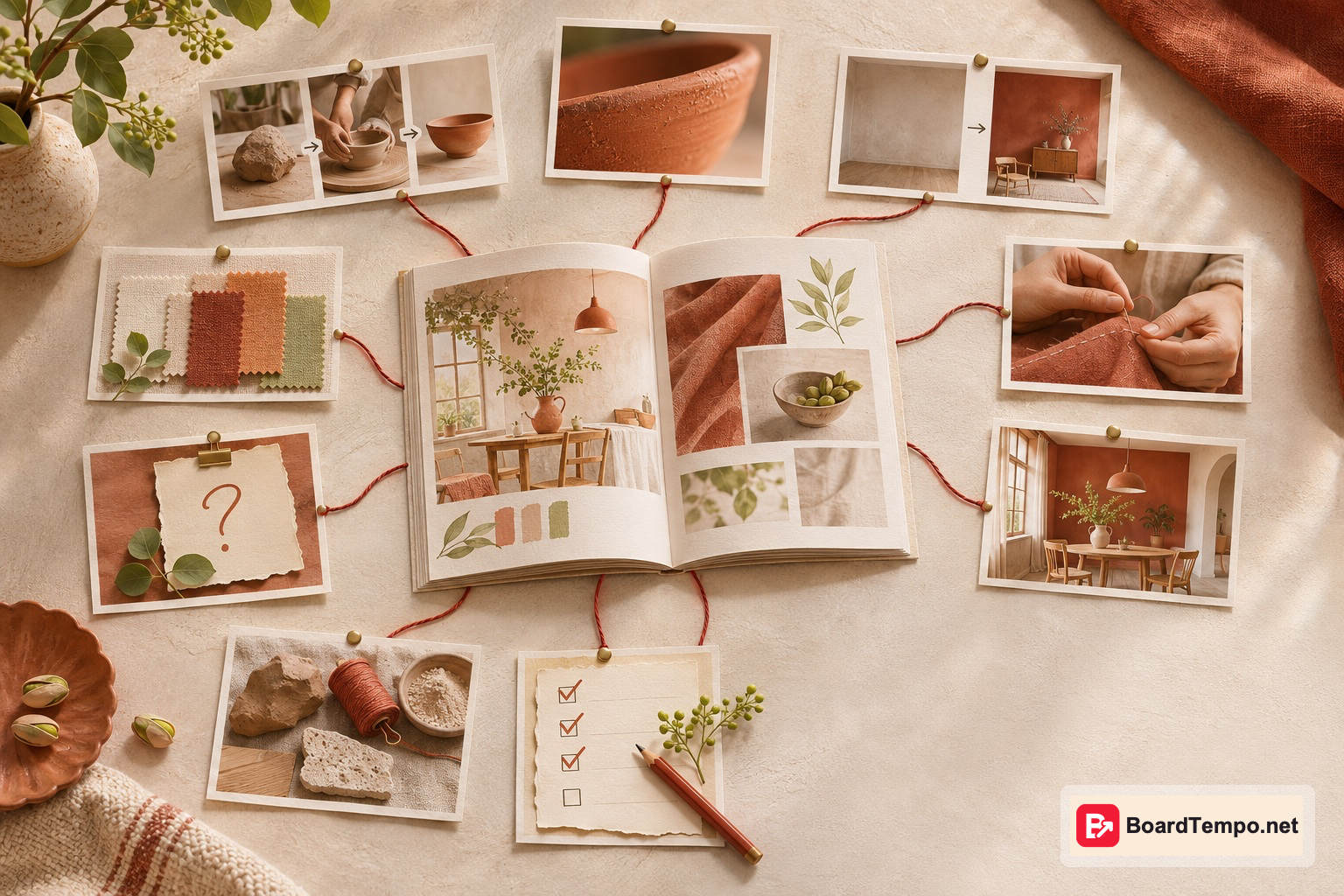
“Let’s make nine Pins” sounds productive until you open the ninth blank canvas. Start somewhere else: with nine reader questions. If the article genuinely answers only four, keep four. The other five do not need to appear through sheer editorial determination.
This workshop uses a fictional pottery studio and a proposed article, “Choosing a handmade mug as a gift”. That product guide does not exist here. What follows is its editorial production map. None of the sample Pins should be published until the relevant sections and real supporting evidence are ready.
Our one-article, several-Pins guide explains the basic principle. This exercise goes further by creating a brief and an acceptance condition for every concept. It gives a writer and designer something more useful than “make it engaging”, which tends to mean seven different things to seven different people.
Collect the evidence before counting the designs
The proposed guide needs actual product dimensions, photographs with a useful sense of scale, manufacturer care instructions, and real personalization, packaging and delivery terms. Don’t borrow facts from a similar-looking mug. Handmade pieces can differ even when their photographs look remarkably alike.
Create six columns: question, promise, evidence, visual, destination section and status. Keep the status column. “Interesting idea” and “ready to publish” are different states, sometimes separated by an entire photoshoot.
Nine production cards
1. Capacity. Question: will this suit a small coffee or a generous tea? Promise: help match a drinking habit to a size. Evidence: verified capacities and an explanation of measurement. Visual: two actual pieces beside a measuring jug. Section: “Size”. Without the measurements, the card remains a draft.
2. Handle shape. Question: what should a buyer notice about the grip? Promise: show the relevant details. Evidence: close-up photographs and dimensions. Visual: an original photograph of a hand holding the piece. Section: “Shape”. Avoid claiming universal comfort: hands and habits differ.
3. Colour in different light. Question: why might the glaze look different at home? Promise: show this specific finish under two lighting conditions. Evidence: photographs of the same object without misleading processing changes. Visual: a clearly labelled pair. Section: “Colour”. Generated images cannot prove how an actual glaze changes in real light.
4. Care. Question: can it go in the dishwasher? Promise: explain this maker’s recommendation for this item. Evidence: confirmed product-care information. Visual: the mug and a concise care card. Section: “Using it”. Never generalize one glaze’s properties to all handmade ceramics.
5. Pairing two pieces. Question: does a gift set have to match perfectly? Promise: show three considered combinations. Evidence: original photographs of available pieces together. Visual: a pair on a simple tabletop. Section: “Combinations”. Present these as styling suggestions, not the objectively correct way to choose a gift.
6. Personalization. Question: can the recipient’s name be added? Promise: explain available options and lead times. Evidence: the studio’s actual terms and an authorized example. Visual: a close-up using a fictional name or an approved sample. Section: “Custom orders”. A lovely idea is not a service the business necessarily offers.
7. Packaging. Question: what will arrive, and how will it look when given? Promise: show the supplied package. Evidence: a real photograph and an accurate contents list. Visual: an opened box. Section: “In the box”. Flowers used as styling props should not accidentally become part of the promised purchase.
8. Timing. Question: could it arrive before a particular occasion? Promise: distinguish making, dispatch and delivery. Evidence: current seller information without invented courier guarantees. Visual: a simple three-stage timeline. Section: “When to order”. Update deadlines and retire seasonal claims when they expire.
9. An unfamiliar recipient. Question: what if the buyer doesn’t know the person’s taste? Promise: offer three ways to narrow the choice. Evidence: practical questions and genuine alternatives from the studio. Visual: a small decision map. Section: “When you’re unsure”. Mention gift cards only if the business actually sells them.
A new story or merely a new wrapper?
Compare the cards without their images. If two rows ask the same question and give the same answer, they are probably visual variants of one concept. Testing those variants can be useful, but calling them separate useful topics does not make them so.
Each of our nine cards needs different evidence. That is the point of the map: it exposes missing content before anyone generates artwork. Sometimes the most valuable outcome is not Pin number nine, but discovering that the website never explains delivery.
Review before design
The writer checks the facts and destination section. The designer explains what the image will show. The editor compares the promise with the evidence. One person may wear several hats, but the questions still deserve separate attention.
Research candidate keywords for each card independently. “Handmade mug gift”, “choosing a mug size” and “pottery gift packaging” are working hypotheses here, not measured demand. A popular phrase about a different product is not a shortcut to relevance.
Sources
Let’s talk about it
What could help your project? Share your experience or ask a question.
The discussion will appear here after this article is posted in our Telegram channel and comments are enabled. You can visit the channel meanwhile. Comments are public; you are not automatically subscribed.
Telegram loads only when you click. Telegram may ask you to log in to comment. If the discussion is not available, use the channel link above.