

BoardTempo workshops · 1/8
You sell an interior consultation. What is your client actually searching for?
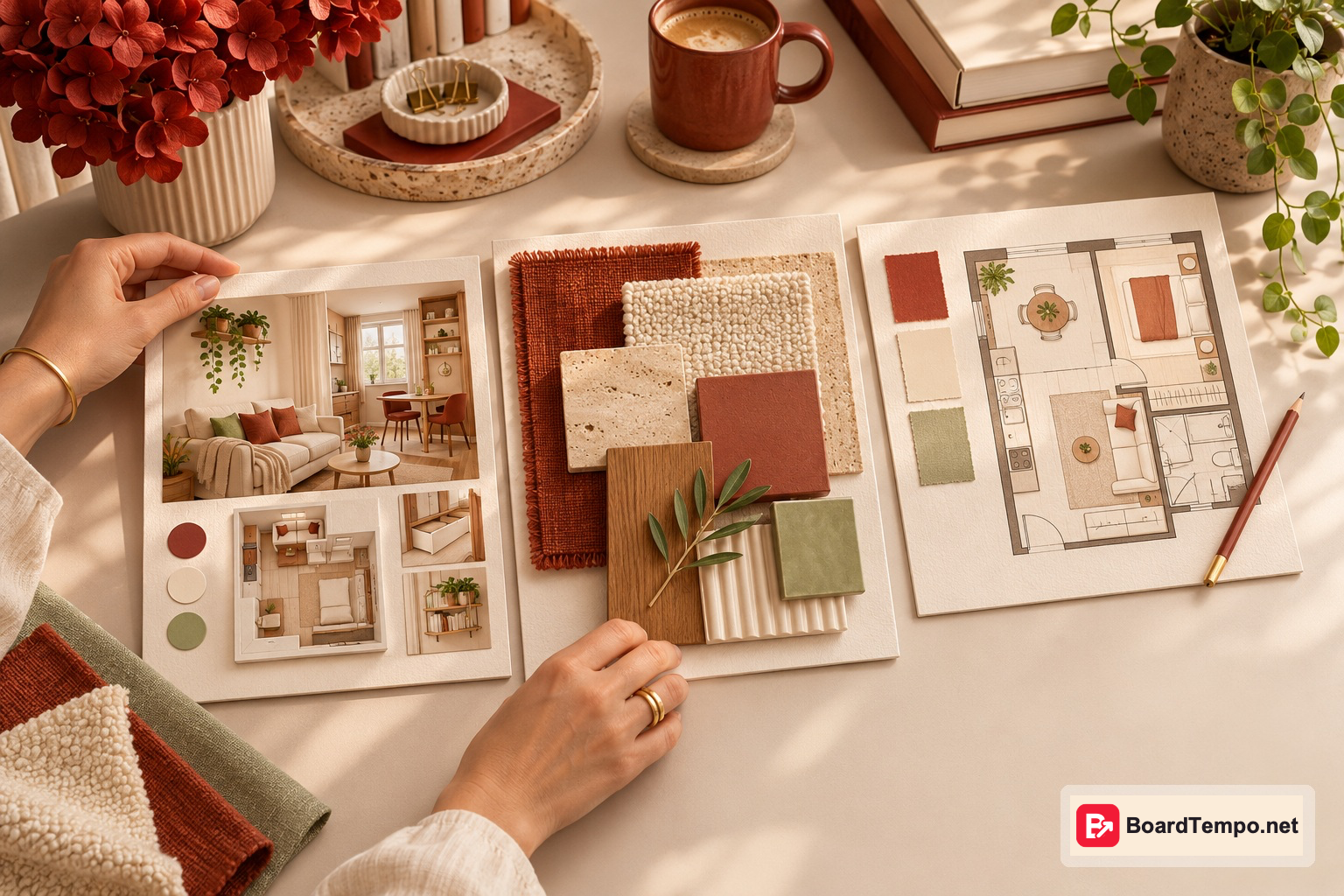
You offer online interior consultations. Your future client is staring at a desk that blocks the living-room door. They may not be looking for a designer yet. They are looking for somewhere to put the desk. That is a much better place to begin the conversation.
This workshop uses an invented service, not a client success story. Our designer helps people rearrange furniture they already own. The deliverable is a layout and practical recommendations, not construction drawings or a renovation-management package. We will build three different routes into that service without making it sound bigger than it is.
Draw the boundary around your offer
Write four short answers: who you help, the situation they face, what they receive and what is excluded. For our example: people in small homes; furniture that makes everyday life awkward; an annotated layout; no structural work or contractor supervision.
That last answer matters. It stops an enthusiastic content session turning into a promise of a free, complete home renovation. A useful pin opens the right door. It does not simply persuade someone to open any door available.
Next, separate professional language from everyday questions. You might say “functional zoning.” A reader might say “a desk in the living room without blocking the walkway.” Treat both as search hypotheses. The phrases in this article are not verified keyword-volume findings.
Route one: help someone imagine a solution
This person is collecting possibilities. Can a living room accommodate a desk? Does the room need a divider? Could the existing furniture stay?
A useful pin concept is “Three living-room workspace layouts without a divider.” Show three genuinely different arrangements, not the same desk rendered in three colours. Its destination should contain the promised layouts and explain the circumstances that suit each one.
The next step can be a short measuring checklist. Do not hide the third arrangement behind a phone-number form. The visitor came for ideas, so deliver the ideas first. A consultation can appear afterwards as an option for a room that does not fit the examples.
Route two: help someone choose
Now the reader likes the idea of a desk behind the sofa, but also has an available wall. More inspiration is not necessarily useful. They need a comparison.
Try “Desk behind the sofa or against the wall? Checks before you move it.” The article can compare access, daylight, sockets and the background visible on video calls. Avoid prescribing a universal clearance measurement for every home: furniture, occupants and applicable requirements differ.
A suitable next step is to compare the two options against a sketch of their own room. Give the reader a decision table, not another attractive image to file away. If measurements are shown in an English-language example, provide the units clearly rather than assuming every reader uses the same system.
Route three: explain how to get help
This visitor already wants to delegate. They need to know what an online session involves, what to prepare and what will arrive afterwards.
A pin titled “What to prepare for an online furniture-layout consultation” can show a measured plan, room photographs and an inventory of furniture to keep. Link to a service page explaining scope, pricing or how quotes are calculated, turnaround and the actual deliverable.
Label a sample layout as a sample. It is not evidence of a completed customer project. If the service has geographic or time-zone restrictions, explain them before someone completes the booking form.
Turn the routes into a working brief
| Reader's job | Pin promise | Destination | Useful next step |
|---|---|---|---|
| Imagine possibilities | Three layouts without a divider | Illustrated layout article | Measure the room |
| Compare options | Checks before moving the desk | Two-layout comparison | Complete a decision table |
| Get professional help | Prepare for a consultation | Specific service page | Review booking conditions |
These are not three colour variations of one promotion. Each has a different reason to exist. Start by finishing one route, including its destination, rather than producing a large batch of images for pages that do not yet answer the question.
Check the search, not just your enthusiasm
Investigate phrases such as “living room office layout,” “desk behind sofa” and “online room layout consultation.” Record the language, date and kind of results you see: inspiration, shopping, tutorials or professional services. A phrase returning desks for sale may need a different angle from a phrase returning room plans.
Do not call a query high-intent simply because your business would like it to be. The keyword-research guide explains the basic checking process. Our three-route framework is an editorial planning tool, not an official Pinterest taxonomy or a ranking guarantee.
Sources
Let’s talk about it
What could help your project? Share your experience or ask a question.
The discussion will appear here after this article is posted in our Telegram channel and comments are enabled. You can visit the channel meanwhile. Comments are public; you are not automatically subscribed.
Telegram loads only when you click. Telegram may ask you to log in to comment. If the discussion is not available, use the channel link above.