

Find Pinterest keywords that can become useful articles
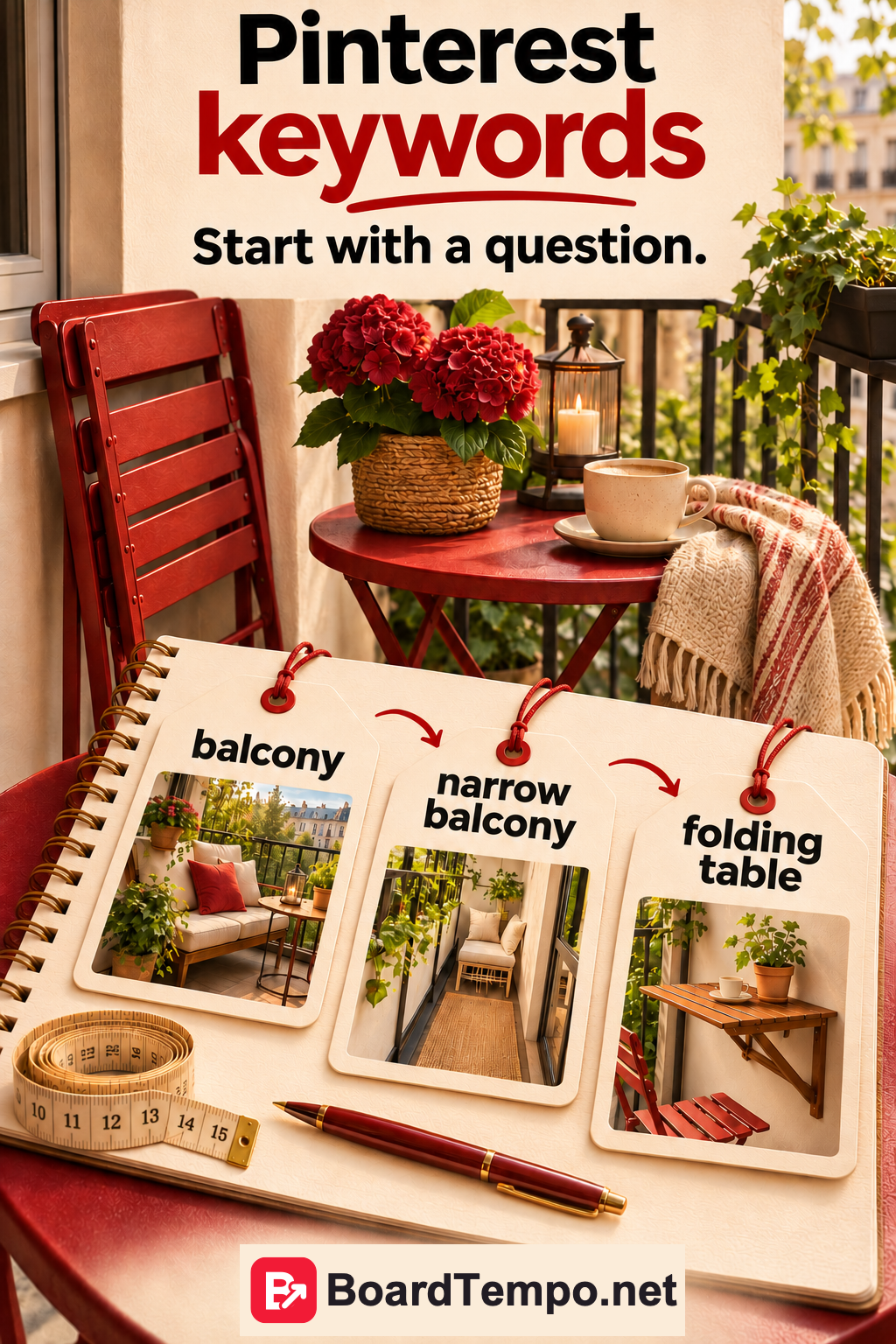
You make furniture for small apartments. You type “furniture” into search and get everything from enormous sofas to garden chairs. Lovely, but your fold-down table for a narrow balcony is rather lost in the crowd.
Instead of searching the whole furniture world, start with a problem your work can solve.
Begin with a customer's question
Look through the questions you already receive: “Will there still be room to walk past?” “Can I fold it away after breakfast?” “What does it look like closed?”
Those suggest phrases to investigate: “table for a narrow balcony,” “folding balcony table,” “small balcony furniture.” These are starting ideas, not measured search demand. Next, we check what Pinterest actually shows for them.
“Furniture” describes a whole shop. “Table for a narrow balcony” gives your product something specific to answer.
Look beyond the suggestions
Enter a phrase in Pinterest. Note relevant search suggestions if they appear, then examine the results. Are the Pins about buying furniture, building it yourself or simply admiring a beautiful balcony?
If most results are DIY plans but you sell finished tables, try more precise searches around choosing a table or getting the dimensions right. DIY readers are not a bad audience. They are just doing a different job.
Record what you saw, not only the phrase. “Folding table” will tell you little next week. “Mostly building plans; we sell a finished table” will save you repeating the same search.
Group the ideas by purpose
Try three groups: choosing a table, fitting it onto a balcony, and building one. Leave the last group aside if you do not provide construction instructions.
Closely related questions about dimensions and keeping a walkway clear can belong in one article. You do not need a separate piece for every change in word order. A comparison of models and a detailed construction tutorial, however, are different articles.
For each proposed title, finish this sentence: “After reading, I will understand or be able to choose…” If you cannot, the idea needs more work before it becomes a writing brief.
Where Pinterest Trends helps
Trends can show how interest in a topic changes over time in supported regions. Check the country and date range: preparing a balcony for summer does not happen at the same time everywhere.
Its graphs do not give an absolute number of searches. Pinterest uses a relative index: 100 represents the peak on the relevant graph, not a hundred buyers or a hundred thousand searches. Available features can vary by region.
If the topic or region you need is unavailable, leave that field blank. Another country's data may offer a clue, but it is not a measurement of local demand.
A useful research note
Phrase: “table for a narrow balcony.”
Question to investigate: do the results suggest interest in ready-made tables and advice on positioning them?
What we can show: the table open and folded, its dimensions and the space left to walk past.
Possible article: “How to choose a table for a narrow balcony without blocking the walkway.”
Status: not checked yet. After searching, add the date and what you found: finished tables, plans or interior inspiration.
That is shorter than a thousand-row export, but a writer can work with it. They will not have to guess why a table, balcony renovation and a garden bench ended up in the same brief.
Try it with your own customers
Take five questions asked before a purchase or booking. Turn each into a phrase someone might type into search. Check the results and keep the directions where you have a worthwhile answer.
The next job is to turn that topic into a clear Pin title and description, not a comma-separated heap of keywords.
Sources
Let’s talk about it
What could help your project? Share your experience or ask a question.
The discussion will appear here after this article is posted in our Telegram channel and comments are enabled. You can visit the channel meanwhile. Comments are public; you are not automatically subscribed.
Telegram loads only when you click. Telegram may ask you to log in to comment. If the discussion is not available, use the channel link above.