

What to post on Pinterest when you feel you've shown everything
You open the editor and pick a beautiful background. Now you just need something to say. Half an hour later, the background is still beautiful. The idea hasn't arrived.
Let's try it the other way round. Instead of waiting for inspiration inside an empty design, look at what happens in your business. There's usually more to talk about than you think.
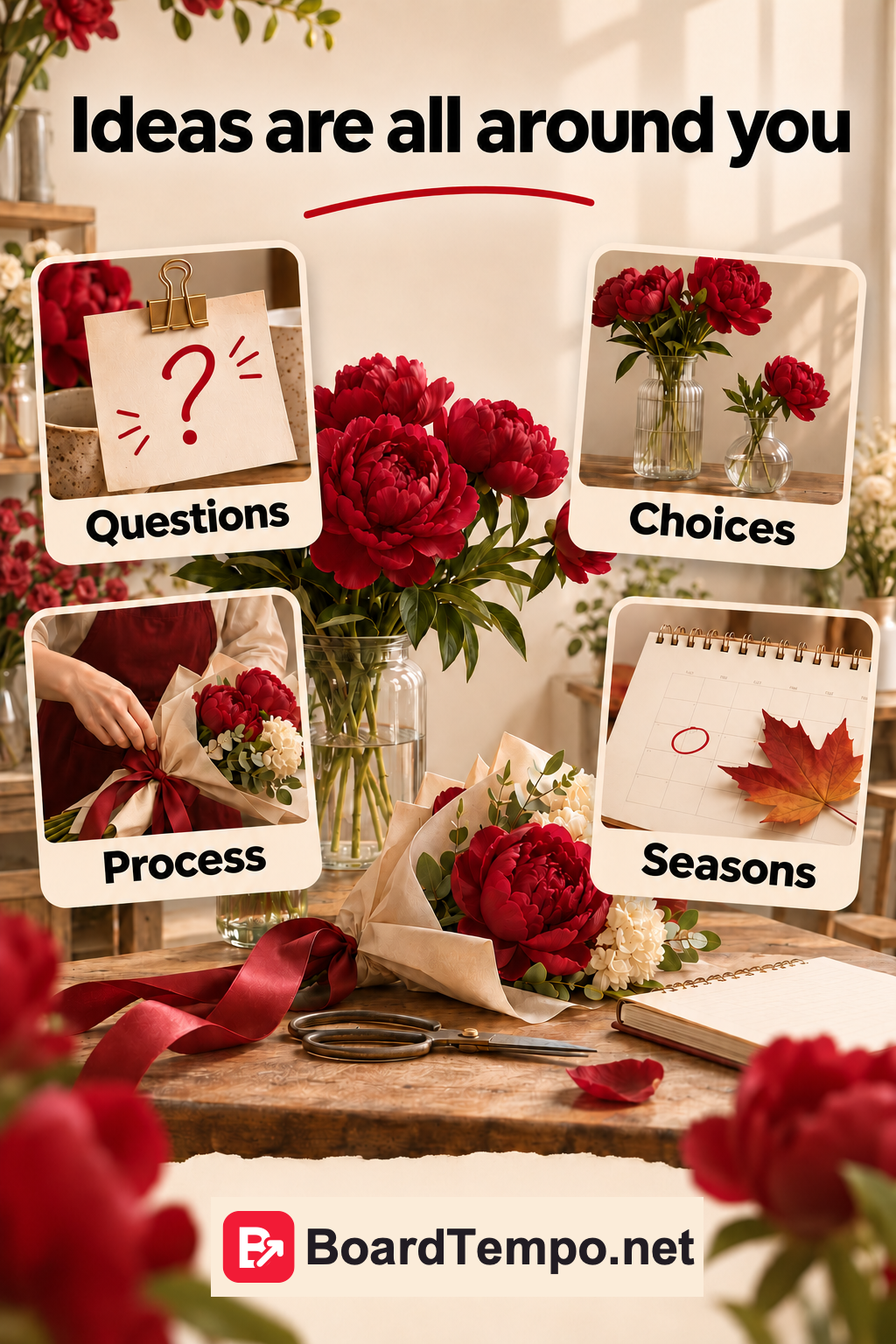
Start with questions you've already been asked
Look through your replies to customers. What did they ask before ordering? What were they unsure about? What did they want to see close up?
A florist might hear, “Will this bouquet fit in a normal vase, or does it need a wide one?” That's the start of a short guide to choosing a vase for a bouquet, with two clear examples. A jewellery maker might be asked, “How can I tell how long this chain is from the photo?” That calls for an explanation of lengths, not another picture of a necklace on a white background.
Write down the question, without names or personal details. Five is enough to start with. You don't need to turn a customer's private message into a public screenshot.
Look at the choices your customers have to make
You can instantly tell the difference between two similar products in your range. A customer may not. That difference is worth explaining.
Two makeup bags are the same size, but one opens wide while the other unzips only at the top. Two bouquets cost about the same, but one fits on a small table and the other needs more space. One sewing lesson only needs a straight stitch; another assumes a little experience.
There are three topics about making a choice. Show the real differences, rather than inventing faults in one option to sell the other.
Show what usually stays behind the scenes
When you do something every day, it stops looking interesting to you. Your customers don't get to see it, though.
How do you choose a ribbon colour for a bouquet? Why do you line up the pattern on two fabric pieces before sewing? How do you check that a finished bag fits the laptop size you've stated?
You don't have to reveal the entire process. Pick one moment and explain why it matters. “Watch me work” becomes “Why the pattern sometimes doesn't line up at a seam.” Now you know which photographs would help.
If the action is easier to show in motion, use a short video. Decide what you want to explain before choosing the music.
Use the season when it's relevant
A florist's available flowers change. A sewing studio gets orders for the start of the school year. An interiors blog receives questions about spring balcony makeovers. That doesn't mean every holiday needs a post from you.
Check Pinterest Trends if your country and search term are available. You can select a region and see how interest changes over time. That can help you notice when searches begin, rather than remembering the topic on the holiday itself.
A value of 100 on the chart doesn't mean 100 customers or 100,000 searches. Pinterest uses a normalized interest index. If there is no data for your topic, don't substitute a nice-looking chart from another country. Keep the idea and check it against other clues: customer questions, orders and search suggestions. Search suggestions don't provide exact search counts either.
Choose one idea you can properly explain
Beside each topic, note three things: what you need to explain, what you can show and what page you'll prepare on your website.
For “How to choose a vase for a bouquet,” that might be: explain why the neck width matters; show two of your bouquets in suitable vases; write a short article with examples and the dimensions of those vases.
No photos yet? That's a job for your next shoot, not a bad idea. Don't know the answer yourself yet? Find it out first. A confident Pin headline won't do that work for you.
Choose a topic you already understand and have material for. By the end of the evening, you'll have a concrete task: photograph two examples and write the explanation. Much more useful than “We need more content.”
What if the article is already written?
Here, we've been finding new subjects worth covering. Once an article exists, the question changes: how can you introduce it to different readers? We explore that in “One article, several Pins.”
Keep those as two separate lists: topics for future articles, and ways to present the articles you already have. It becomes easier to see what you need next: a new explanation, or a better way to show an existing one.
Source
Let’s talk about it
What could help your project? Share your experience or ask a question.
The discussion will appear here after this article is posted in our Telegram channel and comments are enabled. You can visit the channel meanwhile. Comments are public; you are not automatically subscribed.
Telegram loads only when you click. Telegram may ask you to log in to comment. If the discussion is not available, use the channel link above.