

Before you publish a Pin: five things worth checking
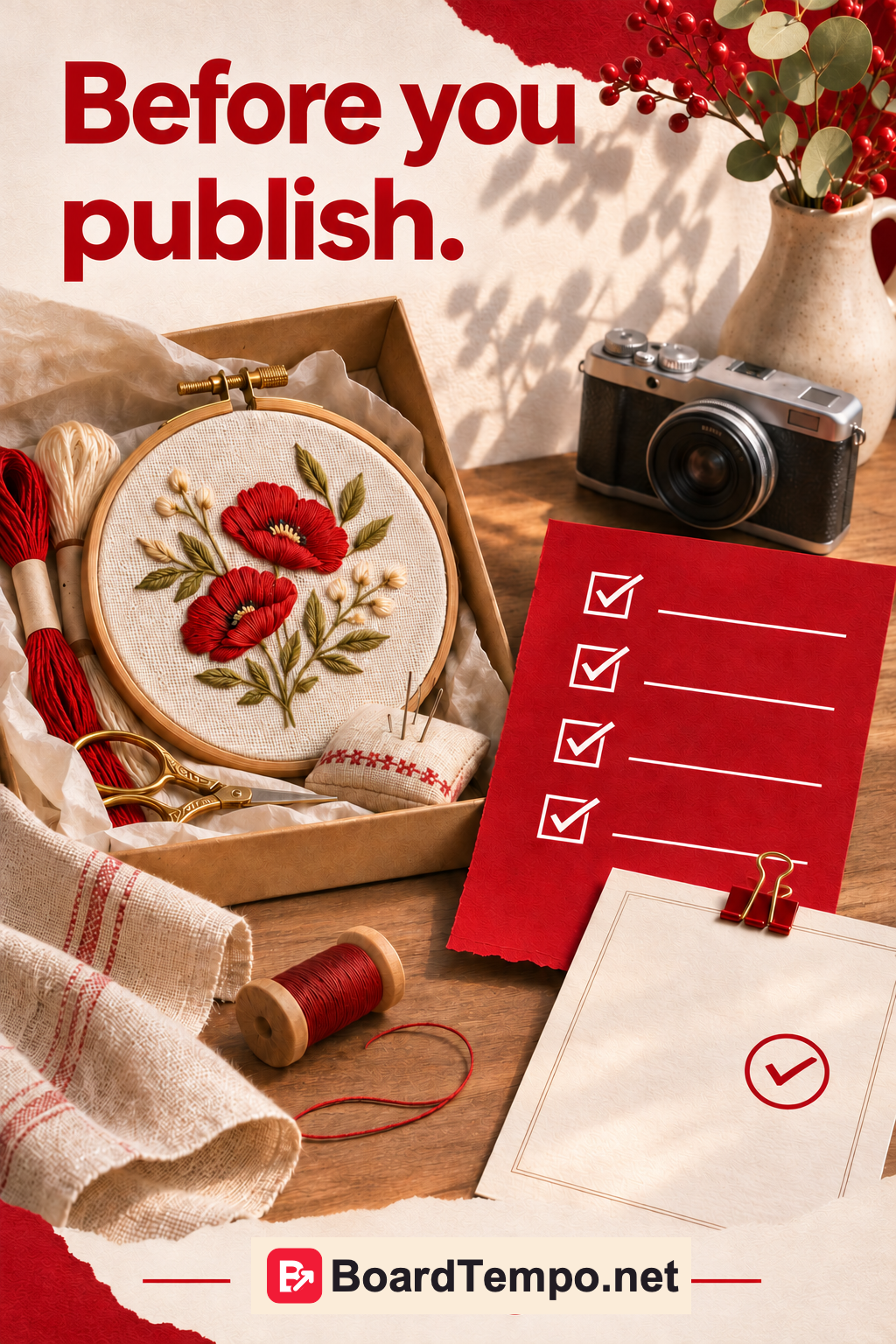
A good photo, your headline and a link. Ready to publish? Almost. The photo may belong to someone else, the link may hold a surprise, and the headline may promise something the page never delivers.
Let's check a practical example: an embroidery shop preparing a Pin about a first project for beginners.
1. Where did the photo come from?
If you photographed your own kit, you know where the original is. If you licensed a stock photo, keep the licence and check that it covers your intended use. If a designer supplied the layout, ask where the photo came from.
“Found it on Pinterest” tells you where you discovered it, not whether you may reuse it. Saving someone's Pin to a board is different from downloading their image and publishing it as your own. Crediting the photographer does not replace permission.
For our kit, show the real fabric, threads, pattern and finished embroidery. Buyers want to know what arrives in the parcel. An AI-generated result that cannot be made with the kit would only confuse them.
2. What does the headline promise?
“Your first embroidery kit: what's inside” sets a clear expectation. The page should show the contents and explain which extra tools are needed.
“Learn embroidery in an evening” sounds livelier, but can you honestly promise that to every beginner? Show a specific advantage instead: a large printed chart, a limited colour palette or clear instructions for the first stitches.
Check the small claims too. If the pattern is “free,” can readers get it on the stated terms? If “everything is included,” does that include the needle?
3. Where does the link go?
Open it on your phone as a new visitor. Is the right kit easy to find? Do the photos load? Is it still available?
If it has been discontinued, explain that and offer a relevant alternative. Do not silently replace the promised page with a random catalogue. Use a current destination for new Pins.
Pinterest treats misleading links and unwanted redirects as problems. They are also simply irritating: you came for an embroidery pattern, not a smartphone giveaway.
4. Is the commercial relationship clear?
If you may earn a commission when someone buys through the link, say so near the recommendation. For example: “Affiliate link: I may earn a commission if you buy through this link.” Paid partnerships also need an appropriate disclosure.
Pinterest has specific commercial-content rules, and local requirements vary. One hashtag is not a universal answer for every country and every publication.
5. Does the promotion look like spam?
Dozens of identical Pins, unrelated popular search terms and mass promotional comments are not a content strategy. Pinterest prohibits spam and artificial engagement.
Give each publication a useful purpose: show the contents, explain the chart or demonstrate the finished size. That is a better reason to appear in someone's feed than simply taking up another slot.
The final minute
Open the image and destination side by side. Check your image rights, accuracy of the result, headline promise, working link and any required disclosure. If a parcel appears in the photo, make sure nobody's address or phone number is visible.
Something does not match? Fix it before publishing. Five minutes now beats searching for a licence after a complaint.
Read next
Where does your Pin lead?
https://boardtempo.net/en/guides/where-does-your-pin-lead/
Sources
Pinterest Community Guidelines: https://policy.pinterest.com/en/community-guidelines
Commercial and Branded Content Guidelines: https://policy.pinterest.com/en/commercial-and-branded-content-guidelines
Let’s talk about it
What could help your project? Share your experience or ask a question.
The discussion will appear here after this article is posted in our Telegram channel and comments are enabled. You can visit the channel meanwhile. Comments are public; you are not automatically subscribed.
Telegram loads only when you click. Telegram may ask you to log in to comment. If the discussion is not available, use the channel link above.